What Are the Best China Steel Patio Doors for Global Buyers?
Choosing the best steel patio doors from China requires more than comparing prices or polished showroom photographs. Global buyers should examine steel grade, welding quality, thermal breaks, glazing performance, corrosion protection, and hardware durability. The World Steel Association reported approximately 1.89 billion tonnes of crude steel production worldwide in 2023, showing the industry’s enormous manufacturing capacity. However, scale does not guarantee consistent door quality. Supplier experience still matters.
Steel is strong. Yet it conducts heat efficiently. The U.S. Department of Energy states that windows and doors can represent 25% to 30% of residential heating and cooling energy use. This makes insulated frames, low-emissivity glass, weather seals, and correct installation essential for energy-conscious projects. Buyers should request tested U-values, air-leakage results, water-penetration data, and wind-load performance. Standards from organizations such as ASTM International, NFRC, and ISO can provide useful reference points, although certificates must match the actual product supplied.
The strongest steel patio doors combine narrow sightlines, reliable security hardware, smooth operation, and long-term resistance to rain, salt air, and ultraviolet exposure. Factory inspections, sample testing, and clear packing specifications reduce unpleasant surprises during international shipping. Details matter. A door may look excellent in a catalog but perform poorly after repeated opening, temperature changes, or coastal exposure. No ranking is perfect. Therefore, this guide evaluates Chinese suppliers through measurable performance, documented manufacturing experience, responsive technical support, and realistic total cost. The best choice is not always the cheapest door. It is the one that remains safe, attractive, and functional after years of daily use.
What Defines a High-Quality China Steel Patio Door?
A high-quality China steel patio door begins with its structure, not its appearance.
Inspect the frame corners for clean welds, even joints, and minimal distortion. Galvanized steel can improve corrosion resistance, while a well-applied powder coating protects exposed surfaces. The finish should feel consistent around corners and drainage points. Small defects often appear there first.
Thermal performance matters in different climates.
Look for insulated glass, continuous weather seals, and a thermally improved frame design. Ask for tested U-values, air-infiltration results, and water-penetration data. These documents are more useful than attractive showroom photographs.
A strong threshold should drain rainwater outward, not into the room. Check the rollers, locks, and hinges by opening the door repeatedly. It should move smoothly without scraping or excessive force.
Details decide long-term value.
Stainless or corrosion-resistant hardware helps in coastal regions, but it still needs suitable maintenance. Confirm glass thickness, safety glazing requirements, warranty terms, replacement parts, and installation instructions before ordering. Independent inspection can reveal weak packaging, loose fittings, or inconsistent dimensions. No door is flawless. Even a carefully engineered unit may perform poorly when installed on an uneven opening. This is where buyers sometimes focus too much on factory price and too little on site preparation. A qualified installer should measure the opening, seal the perimeter correctly, and leave room for seasonal movement.
Which Steel Patio Door Styles Suit Different Global Projects?
The best China steel patio door depends on the project, not only the appearance.
For compact apartments, slim-framed sliding doors save floor space and create wide balcony openings. Their simple movement suits urban homes, hotels, and renovated buildings. However, heavy glass panels need correctly sized rollers and reinforced tracks. A beautiful frame cannot compensate for poor installation.
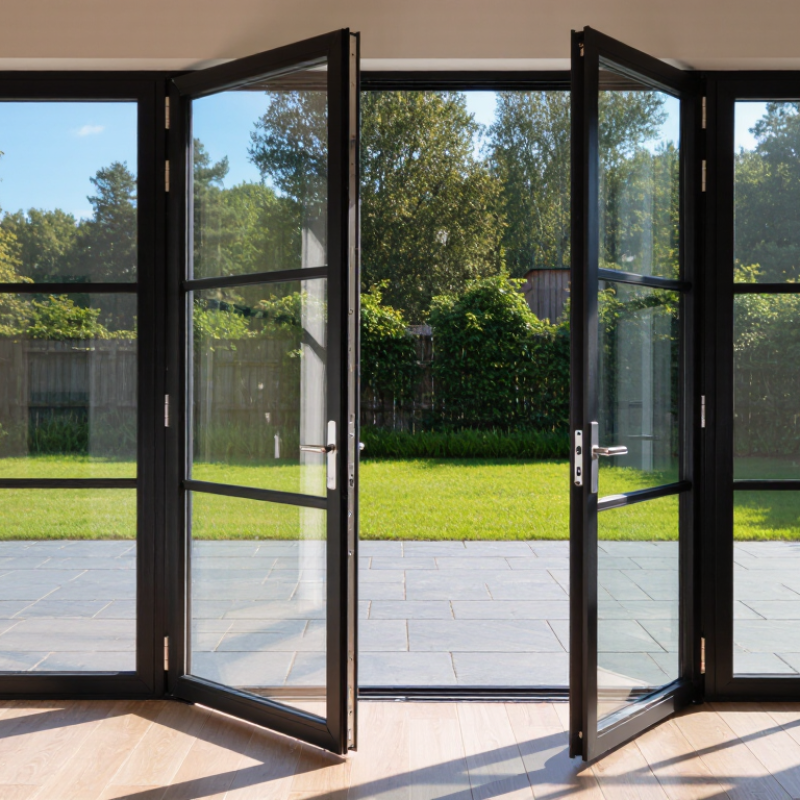
French steel patio doors fit villas, restaurants, and heritage-style projects. Their narrow sightlines provide a traditional rhythm, while inward or outward operation supports flexible room planning. For large terraces, folding steel doors can connect dining areas with gardens. They require more wall clearance and careful alignment. I have seen folding systems lose smooth movement when the threshold was not level.
Different climates also change the suitable style.
Thermally broken steel frames are valuable in cold regions and strongly air-conditioned buildings. Coastal projects need durable surface treatment, stainless hardware, and drainage details that resist salty moisture. In windy locations, buyers should request tested water resistance, air leakage, and structural performance. The specification must match local building requirements.
For commercial developments, sliding systems often simplify daily traffic and maintenance. For private homes, French or folding doors may provide stronger visual character. Yet preferences can mislead decisions. A slim frame may reduce thermal performance, and oversized glass may increase handling risks. Confirm opening dimensions, glass configuration, finish samples, spare parts, and installation guidance before production.
How to Compare Materials, Glass, Hardware, and Thermal Performance?
Global buyers comparing steel patio doors should begin with the opening’s climate, not appearance. A slim frame can look elegant beside a coastal terrace, yet untreated steel may develop surface corrosion in salty air. Use galvanized or corrosion-resistant steel, and inspect welds, drainage paths, and powder-coat coverage. Ask for documented coating tests and project references from similar climates. Photos help, but physical samples reveal more.
Glass changes comfort more than many buyers expect. For cold regions, insulated low-emissivity glass with warm-edge spacers reduces interior condensation and heat loss. In hot, sunny zones, solar-control glass can limit glare and cooling demand. Laminated glass adds safety and reduces noise, while tempered glass handles impact differently. Check U-value, solar heat gain coefficient, visible transmittance, and testing standards together. A low U-value alone is not enough. Hardware matters too. Multi-point locks, stainless rollers, adjustable hinges, and replaceable seals support daily use. Still, more locking points can mean harder operation when the frame settles.
Thermal performance depends on the whole door, not the steel panel alone. Request whole-unit test results, including air leakage, water penetration, and thermal transmittance. A thermally broken frame separates interior and exterior steel with an insulating barrier. This detail matters near a winter sofa or a sun-heated dining room. Installation can still fail. Confirm sill height, threshold drainage, expansion gaps, and local installer training before ordering. I would question optimistic claims without independent reports; some catalogs simplify real-world performance. That caution may slow procurement, but replacement work costs more.
Best China Steel Patio Door Benchmark for Global Buyers
Representative whole-door U-factor comparison for common patio-door constructions. Lower U-factor indicates better thermal insulation.
Typical benchmark values shown in W/m²·K assume insulated frames, double low-E argon glazing, properly sealed joints, and correctly installed hardware. Actual performance varies with door size, frame geometry, glass spacer, weather seals, multi-point locking, and installation quality. For international procurement, request independently tested whole-door U-factor and air-leakage results under the target market standard.
What Standards and Certifications Should International Buyers Check?
What Are the Best China Steel Patio Doors for Global Buyers?
International buyers should verify standards before comparing prices. The IEA’s 2023 Global Status Report states that buildings use about 30% of global final energy. The U.S. Department of Energy also reports that windows can cause 25–30% of residential heating and cooling energy loss. Steel patio doors need more than attractive frames.
For European projects, check EN 14351-1 performance documentation and the applicable CE Declaration of Performance. Request test results for air permeability under EN 12207, watertightness under EN 12208, and wind resistance under EN 12210.
Thermal transmittance should follow ISO 10077 calculations or validated laboratory testing. These details matter near coastal sites, where wind-driven rain can expose weak drainage design.
For North American projects, review NFRC-rated U-factor and solar heat gain coefficient values. The NFRC label also helps verify visible transmittance and air leakage. Ask whether testing followed AAMA/WDMA/CSA 101/I.S.2/A440 or relevant local requirements. Laboratory reports should come from ISO/IEC 17025-accredited facilities, with the exact model and hardware listed.
A certificate alone is not proof.
Check sample doors, gasket corners, weld quality, threshold drainage, and lock alignment. Ask for batch traceability and installation instructions. I would not trust a copied test report. This remains a common weakness in cross-border purchasing. Verify every number against the supplied configuration.
How to Evaluate Suppliers, Pricing, Shipping, and After-Sales Support?
Global buyers should judge China steel patio doors beyond the factory quotation. Ask for steel grade certificates, coating thickness, weld inspection records, and independent air, water, and wind tests. ISO 9001 certification helps, but it does not prove every shipment meets the same standard. Request recent production photos and a traceable sample.
Price comparisons should use landed cost, not unit price. Include glass type, thermal breaks, hardware, packaging, tooling, minimum order quantity, duties, insurance, and inland delivery. The World Steel Association reported 1.89 billion tonnes of crude steel production in 2023, showing a huge supply base, but quality still varies sharply between suppliers. A cheap frame may hide thin steel, weak drainage, or poor powder coating. I would test one sample before approving a container.
Shipping deserves equal attention. UNCTAD reports that more than 80% of global merchandise trade by volume moves by sea. Confirm container loading plans, moisture protection, corner guards, and damage-report procedures. Clarify whether the quotation uses FOB, CIF, or another Incoterm. After-sales support should include spare rollers, locks, seals, installation drawings, and a defined response time. A written warranty matters, yet exclusions can make it almost useless. Ask for customer references from similar climates. My own caution is simple: a polished factory visit can still miss production mistakes. Random pre-shipment inspection remains worthwhile.